Skip to content

A question that frequently comes up is, "Is there any way I can use that database that (insert name of another UH campus) has that we don't?" The short answer is no. The terms of our subscriptions require libraries to only allow access by that library's users (i.e., a campus's students, staff, and faculty).

You might, in some cases, be able to physically visit another campus's library to use their database. But whether you actually can or not depends on how strict the database's vendor is.

Why are there databases that only some campuses have access to, if we're all part of one university system? Subscription fees are usually based on FTE — a measure of student enrollment at a campus. A database subscription that includes all campuses is therefore quite costly. Unavoidably, there are many specialized databases that are only subscribed to by one or a few libraries.

If there is a particular article that you are trying to find that's not available in one of our databases, please get in touch with us. We might be able to find another library that can send us a copy of the article, provided that we haven't tried to get a lot of articles from that publication before.

If there is a database (or book, video, periodical etc.) that you think we should acquire, please let us know and we will consider it purchasing or subscribing to it.

Related resources:

A question that frequently comes up is, "Is there any way I can use that database that (insert name of another UH campus) has that we don't?" The short answer is no. The terms of our subscriptions require libraries to only allow access by that library's users (i.e., a campus's students, staff, and faculty).

You might, in some cases, be able to physically visit another campus's library to use their database. But whether you actually can or not depends on how strict the database's vendor is.

Why are there databases that only some campuses have access to, if we're all part of one university system? Subscription fees are usually based on FTE — a measure of student enrollment at a campus. A database subscription that includes all campuses is therefore quite costly. Unavoidably, there are many specialized databases that are only subscribed to by one or a few libraries.

If there is a particular article that you are trying to find that's not available in one of our databases, please get in touch with us. We might be able to find another library that can send us a copy of the article, provided that we haven't tried to get a lot of articles from that publication before.

If there is a database (or book, video, periodical etc.) that you think we should acquire, please let us know and we will consider it purchasing or subscribing to it.

Related resources:

Ebook Central logo

You already know and love Ebook Central, our largest ebook platform with over 282,000 titles. But let's be real--downloading full books for offline reading has always been a bit of a hassle.

That's all about to change! Get ready for the Ebook Central Reader App, launching on August 13, 2025!

This brand-new app is free to download and use, and is designed to make your life easier with improved security, smoother authentication, and an overall superior user experience. It will be your new, streamlined way to download full Ebook Central ebooks, replacing Adobe Digital Editions. You'll still use the Ebook Central platform to discover, read online, and select titles; the app is just your new go-to for full-book offline reading.

For more information on installing and using the Ebook Central Reader App, please refer to this video. You may begin using the app starting August 13, 2025.

If you have any questions, please feel free to reach out to our friendly librarians at lccref@hawaii.edu.

Cartoon robot pointing to the words Ebook Central Research Assistant shown on a laptop.

Artificial intelligence is making its way into nearly every aspect of our lives, and the library is no exception. Several of our electronic resources are actively incorporating AI tools, with many more to come. Ebook Central, our largest ebook platform, has recently implemented its AI-driven Research Assistant.

Researchers may leverage Ebook Central Research Assistant to quickly assess relevance and identify resources that merit further investigation. The tool also facilitates discovery by offering concepts and additional titles that may be of interest. Ready to check it out?

To get started, navigate to Ebook Central from our A-Z Databases list. If you are currently off campus, you may be prompted to log in with your UH credentials first. With more than 280,000 titles available, you're sure to find something of interest. Select a title to reach the book detail page, then click on Read Online.

Screenshot of book detail page prompting you to click on Read Online.

The Research Assistant will automatically load in either the left or right sidebar, depending on the format of the selected ebook. Click on Find chapter in table of contents to see the Research Assistant in action.

Screenshot showing how to select a chapter from within an ebook.

The table of contents will load in the sidebar. Select a chapter from the list.

Screenshot showing how to select a chapter from the list within an ebook.

The chapter text will display in the main screen. Now click on the stars icon to re-load the Research Assistant in the sidebar.

Screenshot showing how to click on the stars to open the Research Assistant.

Research Assistant currently offers three functions. The first is to provide a brief "key takeaway" from the chapter. Click on Show key takeaway from this chapter and the Research Assistant tool will generate it.

Screenshot showing how to generate a key takeaway of the chapter.

The second function is to summarize five important concepts from the chapter. Click on Show concepts discussed in this chapter to generate them.

Screenshot showing how to click on the button to generate key concepts for the chapter.

The third function is to display other Ebook Central titles that feature a key concept generated by Research Assistant. Click on the search icon next to any concept to see additional titles that may be relevant.

Screenshot showing how to click on the search icon to find additional titles that discuss the key concept.
Screenshot showing other titles identified as relevant to the key concept.

Ebook Central Research Assistant is still in beta mode, so we can expect it to evolve and change over time. Important notes:

  • Research Assistant may work better in Firefox or Edge rather than Chrome.
  • The tool is not available for all content in Ebook Central; authors/publishers may opt out, and brief chapters may not provide enough material.
  • The tool analyzes text only (no images).
  • Research Assistant operates on the individual book chapter level, NOT across an entire book or across multiple titles.
  • As always, AI-generated content may not be 100% accurate. Additionally, sensitive terms/content may be blocked.

How do YOU feel about the recent proliferation of AI tools? Personally, I'm remembering all those hours I spent in the library stacks flipping through volume after volume, and feeling a bit jealous right now!

Collage of a person exiting a cave and the book cover for Answering Why.

If you were lucky enough to attend Mark Perna's dynamic presentation at our campus last week, you got a glimpse of his thought-provoking ideas on motivating and educating today's youth. Now's your chance to delve deeper into his insights on the "Why Generation" by experiencing his bestselling book, Answering Why.

Whether you're an educator, parent, or employer, this quick and engaging read offers innovative approaches to understanding, empowering, and communicating with members of Gen Z--the generation that Perna argues is NOT lazy and entitled, but just needs to know WHY.

Answering Why is now available at Leeward CC Library in three different formats:

Collage showing print, audiobook and ebook formats for Answering Why.

As a reminder, all current Leeward CC faculty, staff and students have access to the library's ebooks, audiobooks, and other electronic resources. If you are currently off campus, you may be prompted to log in with your UH credentials first.

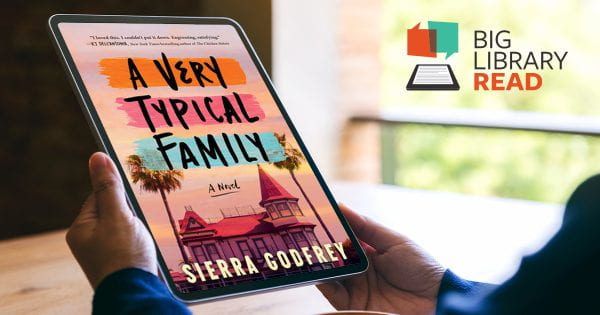
Screenshot of cover art for A Very Typical Family.

The Big Library Read, hosted by OverDrive, comes but thrice a year. If you've been wanting to join in on the fun, you're in luck! The summer Big Library Read is happening NOW, July 13-27, 2023.

Billed as "the first global ebook club," the Big Library Read offers one title, free of charge, to OverDrive users around the world. This summer's selection is A Very Typical Family by Sierra Godfrey.

About the book

Cover photo of A Very Typical Family.

Natalie Walker is the reason her older brother and sister went to prison over 15 years ago. She fled California shortly after that fateful night and hasn’t spoken to anyone in her family since. Now, on the same day her boyfriend steals her dream job out from under her, Natalie receives a letter from a lawyer saying her estranged mother has died and left the family’s historic Santa Cruz house to her. Sort of. The only way for Natalie and her siblings to inherit is for all three adult children to come back and claim it—together.

Written with delightfully dark humor and characters you can’t help but cheer for, A Very Typical Family is an uplifting family drama that will have you reveling in the power of second chances.

Accessing the book on OverDrive

Ready to read? Just click on these direct links to access A Very Typical Family on OverDrive:

If this is your first time using OverDrive, you're in for a treat! More than 500 ebooks and 4,700 magazines are available for your reading pleasure. We also have a small (but growing) selection of audiobooks--perfect for making those long commutes a little more bearable.

OverDrive screenshot.

For reading on the go, be sure to check out OverDrive's mobile app, Libby. Borrow ebooks, audiobooks, and magazines, then read/listen to them right from the app. You may also manage your loans, even across different OverDrive library collections (such as the Hawaii State Public Library System's). Click on the graphic below for a video introduction to Libby.

Libby promotional graphic.

A discussion board for A Very Typical Family is available, but beware of spoilers! Happy reading!

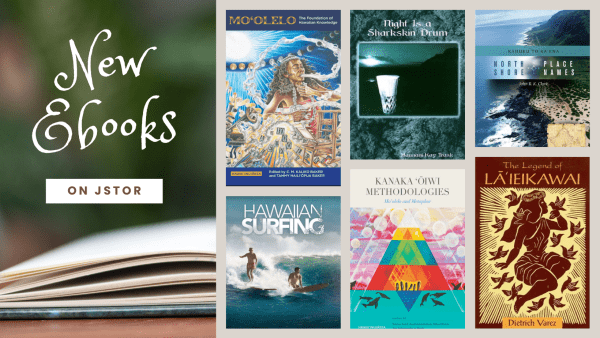
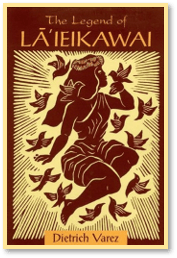
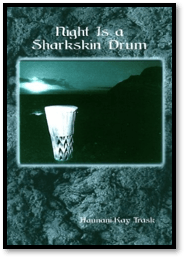
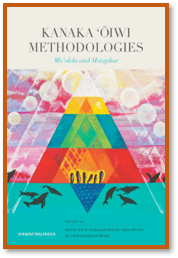
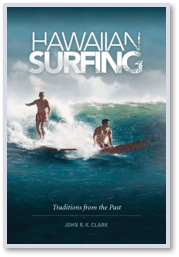
Images of book covers from new JSTOR ebooks.

More good news for ebook lovers! We have recently gained access to 8,000+ titles on JSTOR, including more than 1,000 from University of Hawaiʻi Press! A few notable titles are pictured below.


Cover image of Night is a Sharkskin Drum.

Night is a Sharkskin Drum

Haunani-Kay Trask


Cover image of Kanaka Oiwi Methodologies: Moolelo and Metaphor.

Kanaka ʻŌiwi Methodologies: Moʻolelo and Metaphor

Katrina-Ann R. Kapā‘anaokalāokeola Nākoa Oliveira


Unlike many other database platforms, JSTOR puts no restrictions on the number of simultaneous users or the amount of material that may be downloaded and/or printed from each licensed ebook.

Our JSTOR ebooks are included in our Library Catalog (Primo), but exploring the JSTOR platform directly may also be helpful, since book chapters and journal articles are integrated and cross-searchable.

To access JSTOR, start at our A-Z Databases page and select JSTOR from the list. As with all of our electronic resources, access is available to current Leeward faculty, staff, and students. If you are off campus, you may be prompted to enter your UH login credentials first.

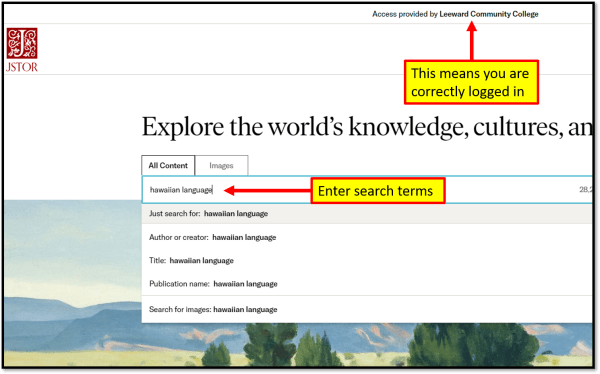
Screenshot of JSTOR home page showing Leeward CC access indication and search terms in search box.

If you see the "Access provided by Leeward Community College" message at the top of the page, you are ready to discover our licensed content on JSTOR. To get started, enter your search terms in the box. If you are looking for a specific book title or author, you may select the appropriate option show in the drop-down menu.

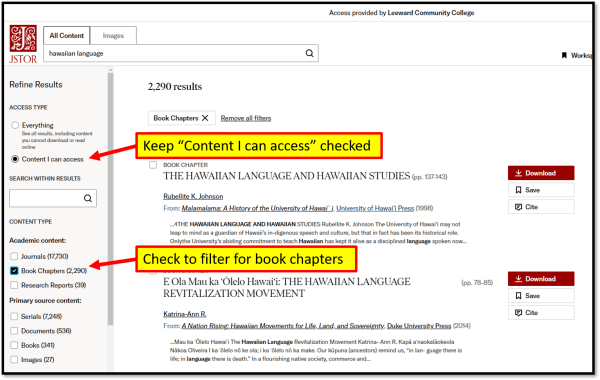
Screenshot of JSTOR search results page showing filters for "Content I can access" and "Book Chapters."

The filters in the left sidebar allow you to refine your search results. Although we have more than 8,000 licensed ebooks on JSTOR, we do NOT have access to every title on the platform, so it is a good idea to keep the "Content I can access" button checked. To filter for book content (not journals), select the "Book Chapters" box.

This 7-minute video offers helpful tips for searching JSTOR.

For more information on JSTOR, including working with items of interest and using the Text Analyzer tool, please see this earlier blog post.


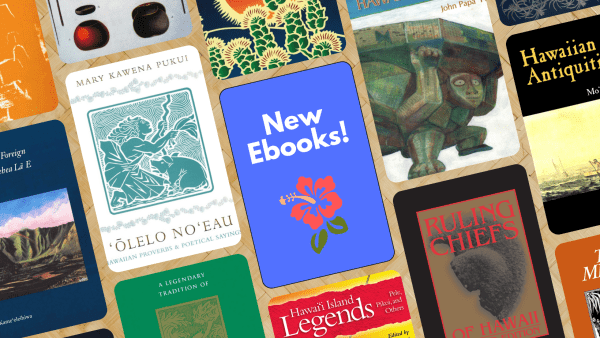
Cover shots of various new ebooks.

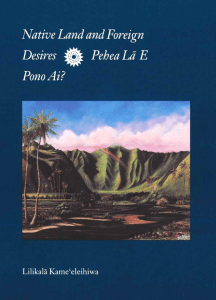
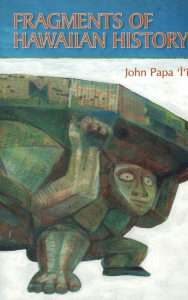
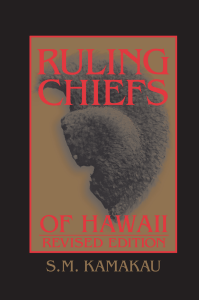
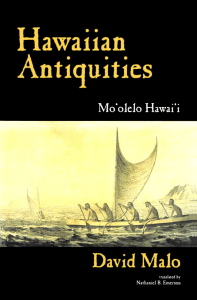
We are excited to provide new electronic access to some treasured Hawaiʻi-Pacific titles!


Cover image of Fragments of Hawaiian History.

Fragments of Hawaiian History

John Papa ʻĪʻī


Cover image of Ruling Chiefs of Hawaiʻi.

Ruling Chiefs of Hawaiʻi

Samuel Kamakau


Other new additions:

Tales of the Menehune
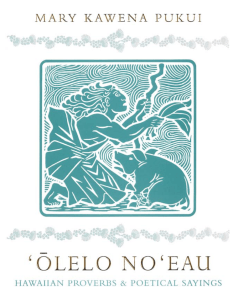
Mary Kawena Pukui

Hawaiʻi Island Legends: Pele, Pīkoi, and Others
Mary Kawena Pukui

Arts and Crafts of Hawaiʻi
Peter Henry Buck

Folktales of Hawaiʻi = He Mau Kaʻao Hawaiʻi
Mary Kawena Pukui

He Moʻolelo Kaʻao o Kamapuaʻa = [A Legendary Tradition of Kamapuaʻa, the Hawaiian Pig-God]
Lilikalā Kame'eleihiwa

The Works of the People of Old = Na Hana a ka Po'e Kahiko
Samuel Manaiakalani Kamakau

Ka Poʻe Kahiko = The People of Old
Samuel Manaiakalani Kamakau

Tales and Traditions of the People of Old = Nā Moʻolelo o ka Poʻe Kahiko
Samuel Manaiakalani Kamakau

Please note that most of these ebooks are limited to one simultaneous user, so if another person is currently accessing the book, you may need to check back a little later.

As with all of our electronic resources, access is available to current Leeward faculty, staff, and students. If you are off campus, you may be prompted to enter your UH login credentials first.

The library now subscribes to MLA Handbook Plus, an online platform which gives access to the 9th edition of the MLA Handbook, the guide to academic writing from the Modern Language Association. Students now have unlimited access to comprehensive guidance for using the MLA citation style. Also in MLA Handbook Plus are two additional e-books: Guide to Digital Literacy and MLA Guide to Undergraduate Research in Literature.

MLA Handbook Plus also has a "Courses" section, which currently features MLA Style 101, a series of short video lessons about the core elements of the MLA citation template. Each lesson shows how to find the information for that element, and how to put that information into a citation.

While the MLA citation style has changed little since the 8th edition of the handbook, the guidance for citing sources has been expanded and reorganized in the 9th edition. Hundreds of sample citations have been added, as have many illustrations. Among the changes to the citation style are an expansion of the contributor element, options for the handling of long URLs, and changes to how social media content is cited. There are also changes to how pseudonyms, Digital Object Identifiers, certain publishers, and publication dates with seasons are shown.

The 9th edition of the handbook has significantly more content than the 8th edition, including bringing back past handbook content not included in the 8th edition. There is new or updated guidance on quotations and paraphrasing, avoiding plagiarism, formatting papers, footnotes and endnotes, and annotated bibliographies. It also has new writing advice, including guidance for spelling, punctuation, abbreviation, grammar, capitalization, and inclusive language.


Sources: EasyBib's MLA 8 vs. MLA 9: Updates and Highlights and MLA's How Does the Ninth Edition of the MLA Handbook Compare with the Eighth Edition? and the What’s New in the Ninth Edition of the MLA Handbook webinar.

Line drawing of a person with a frustrated expression, looking at a computer.
"I could have sworn I saw it here before . . . "

Has this ever happened to you? You stumble upon a series on Netflix, watch every episode, and really enjoy it. A year later, you decide to re-watch it, only to find that it has vanished without a trace! What happened?

In short, Netflix doesn't own all of the content that is made available through the platform. They negotiate licensing agreements with the content owners, and some of these agreements expire. If you want guaranteed access to your favorite show, you usually need to purchase it, either on DVD or through a different streaming service.

Many of the library's electronic resources operate in much the same manner. Read on to learn about two of our main access models--subscription and perpetual--and how the type of model may affect the resources you use.

Subscription model

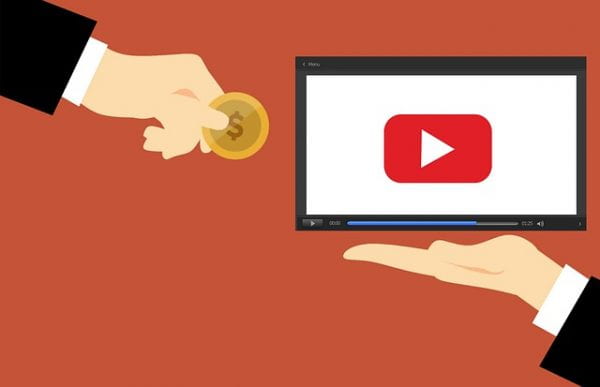
Drawing depicting a financial transaction between a streaming video company and a user.

With the subscription model, we usually pay an annual fee that gives our users access to everything that is currently included in the collection. Examples of subscription resources:

What's great about this model?

  • It offers a large amount of content that would be unaffordable if purchased individually.
  • The collections are continually refreshed with new content.
  • There is usually no limit to the number of simultaneous users.

What's not so great about this model?

  • We cannot select the individual titles included in the collections.
  • A relatively small amount of content is removed periodically, and we have no control over what is removed.

If you've ever found yourself in a situation where you can't find an ebook or video that you know you've seen before, chances are it was a subscription title that was removed from the platform. Vendors generally add and remove content throughout the year, but some do their large removals in the summer and at the end of the year.

For example, this is the list of ebooks that will be removed from Ebook Central after June 30, and this is the list of videos leaving Academic Video Online after July 11.

Perpetual access model

An hourglass on its side.

With the perpetual access model, we purchase the titles we want, and they are ours for as long as we have access to the platform. This purchasing model is available on many of the same platforms that offer subscription collections.

What's great about this model?

  • We select only the titles we want, so we have greater control over the collection.
  • These titles will not disappear unexpectedly.
  • Some ebooks are priced for one, three, or unlimited simultaneous users, so we may select the option that best fits our needs.

What's not so great about this model?

  • Not all titles are available for purchase, and some are only available for one user at a time.
  • Prices can be very high, depending on the title.
  • Titles in rapidly changing fields will be outdated in a few years.

How can I tell if the ebook or video I want to use for my class is going to be there for sure?

Unfortunately, you probably can't tell, so it's best that you contact your library liaison or lccref@hawaii.edu to check. If your title is part of a subscription package, it is sometimes possible to purchase it under a perpetual access model, as well. For some streaming videos, limited-term licenses may also be available; this works well in situations where the video is needed for 1-3 years, but not permanently.

Memo pad with "remember" written on it.

The key takeaway here is that it is a good idea to contact us if you are planning to use an ebook, streaming video, or other library resource for a class assignment or other important purpose. We cannot guarantee that perpetual access will be available for everything, but we will make every effort to prevent unpleasant surprises from happening.

Now, if Netflix would only bring back Friends . . .

Skip to toolbar